
-
 Australia
-
 Austria
-
 Belgium
-
 Brazil
-
 Canada
-
 China
China
-
 Czech Republic
-
 Denmark
-
 Finland
-
 France
-
 Germany
-
 Greece
-
 Hong Kong
-
 Hungary
-
 Iceland
-
 India
India
-
 Ireland
-
 Israel
-
 Italy
Italy
-
 Japan
Japan
-
 Korea
Korea
-
 Luxembourg
-
 Malaysia
-
 Netherlands
-
 New Zealand
-
 Norway
-
 Poland
-
 Qatar
Qatar
-
 Romania
-
 Saudi Arabia
-
 Singapore
-
 Spain
Spain
-
 Sweden
-
 Switzerland
-
 Taiwan
-
 Turkey
-
 United Kingdom
-
 United States
research use only
Optineurin Antibody [D24C11]
Cat.No.: F9272
Application:
Reactivity:
-
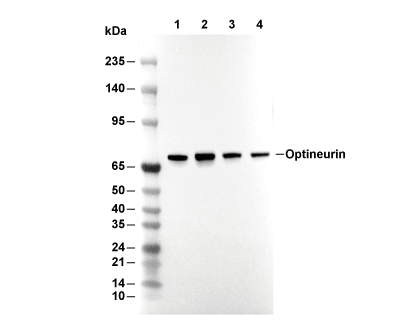 Lane 1: MCF7, Lane 2: U-2OS, Lane 3: Mouse retina, Lane 4: Rat retina
Usage Information
| Dilution |
|---|
|
| Application |
|---|
| WB, IP, IHC |
| Reactivity |
|---|
| Mouse, Rat, Human |
| Source |
|---|
| Rabbit Monoclonal Antibody |
| Storage Buffer |
|---|
| PBS, pH 7.2+50% Glycerol+0.05% BSA+0.01% NaN3 |
| Storage (from the date of receipt) |
|---|
| -20°C (avoid freeze-thaw cycles), 2 years |
| Predicted MW Observed MW |
|---|
| 66 kDa 73 kDa, 68 kDa |
| *Why do the predicted and actual molecular weights differ? The following reasons may explain differences between the predicted and actual protein molecular weight. Post-translational modifications(e.g., phosphorylation, glycosylation); Splice variants and isoforms; Relative charge; Multimerization. |
Biological Description
| Specificity |
|---|
| Optineurin Antibody [D24C11] detects endogenous levels of total Optineurin protein. |
| Clone |
|---|
| D24C11 |
| Synonym(s) |
|---|
| FIP2, GLC1E, HIP7, HYPL, NRP, OPTN, Optineurin, NEMO-related protein, Optic neuropathy-inducing protein, Transcription factor IIIA-interacting protein, FIP-2, HIP-7, TFIIIA-IntP |
| Background |
|---|
| Optineurin is a ubiquitin‑binding adaptor protein encoded by the OPTN gene that localizes mainly to the cytoplasm and membranous compartments, where it integrates vesicular trafficking, selective autophagy, inflammatory signaling, and immune responses. The protein contains multiple functional modules, including N‑terminal coiled‑coil regions that mediate oligomerization and binding to partners such as myosin VI, Rab8, huntingtin, and Tank‑binding kinase 1, an LC3‑interacting region that connects to the autophagosome membrane, and a C‑terminal ubiquitin‑binding domain that recognizes polyubiquitinated cargo. Through this domain architecture, optineurin acts as a scaffold that couples motor proteins and small GTPases to vesicle membranes, guiding post‑Golgi and endocytic trafficking, and directing membrane‑associated cargo toward degradative or secretory routes. Polyubiquitin binding allows optineurin to function as a selective autophagy receptor that targets damaged organelles, invading pathogens, and protein aggregates to the autophagy–lysosome system, where interaction with LC3 promotes engulfment of tagged cargo into autophagosomes and supports autophagosome–lysosome fusion. Association with TBK1 links optineurin to phosphorylation‑dependent control of autophagy and innate immune signaling, with phosphorylated optineurin showing enhanced affinity for ubiquitin chains and LC3, which strengthens capture and clearance of intracellular pathogens and compromised mitochondria. Crosstalk with NF‑κB signaling occurs through optineurin binding to components of the TNF receptor and related pathways, allowing it to modulate inflammatory transcriptional programs and contribute to balanced cytokine responses during infection and tissue stress. Roles in membrane trafficking extend to the maintenance of organelle integrity and secretory pathway function, where optineurin coordinates vesicle movement, organelle positioning, and turnover of membrane proteins, including at the Golgi apparatus and recycling endosomes. In neuronal and muscle contexts, optineurin‑dependent autophagy contributes to the quality control of long‑lived cells, including removal of dysfunctional mitochondria and degradation of signaling regulators that influence differentiation and survival. Mutations and dysregulation of OPTN associate with normal‑tension glaucoma, amyotrophic lateral sclerosis, Paget’s disease of bone, and other neurodegenerative and inflammatory conditions, where altered ubiquitin recognition, defective vesicle trafficking, or impaired autophagosome–lysosome fusion correlate with axonal degeneration, protein aggregate accumulation, and disturbed immune homeostasis. |
| References |
|---|
|
Tech Support
Tel: +1-832-582-8158 Ext:3
If you have any other enquiries, please leave a message.

Products are for research use only. Not for human use. We do not sell to patients.
©Copyright 2013 Selleck Chemicals. All Rights Reserved.